 Support
  Order Parts & Supplies

Throughput vs. Productivity: What’s the Difference in Warehouse Operations?
Every warehouse wants to ship more orders, process more parcels, and keep customers happy. But when conversations turn to performance, two metrics often get lumped together: throughput and productivity.
At first glance, they sound like they measure the same thing. They don’t.
Understanding the difference can help you uncover bottlenecks, make better staffing decisions, and evaluate whether process improvements or automation will actually move the needle. More importantly, it can prevent you from chasing one metric while unintentionally hurting the other.
Let’s break down what each metric means, why both matter, and how they work together to improve warehouse performance.
What Is Throughput?
Throughput measures the amount of work your operation completes within a given period of time. Put simply, it’s a measure of output.
Depending on your operation, throughput might be measured as:
- Parcels processed per hour
- Orders shipped per shift
- Items picked per day
- Cartons sorted per minute
If your facility processes 8,000 parcels during an eight-hour shift, your throughput is 1,000 parcels per hour.
Throughput answers one simple question:
How much work are we getting done?
Several factors influence throughput, including:
- Available labor
- Equipment capacity
- Conveyor or sortation speed
- Order mix
- Inventory availability
- Downstream bottlenecks
Because every process is connected, throughput is only as strong as your weakest link. A fast sortation system won’t increase overall throughput if packing stations can’t keep up. Likewise, adding more workers to picking won’t help if orders begin piling up at shipping.
What Is Productivity?
While throughput measures output, productivity measures how efficiently your operation uses its resources to produce that output.
Those resources include:
- Labor
- Equipment
- Time
- Floor Space
- Operating Costs
One of the most common productivity metrics in warehouse operations is parcels processed per labor hour.
Imagine two facilities, each process 8,000 parcels in a day.
Facility A uses 80 labor hours.
Facility B uses 100 labor hours.
Their throughput is identical, but Facility A is more productive because it achieved the same output with fewer resources.
Productivity answers a different question:
How efficiently are we getting the work done?
Throughput vs. Productivity at a Glance
Although they’re closely related, these metrics tell two different stories.
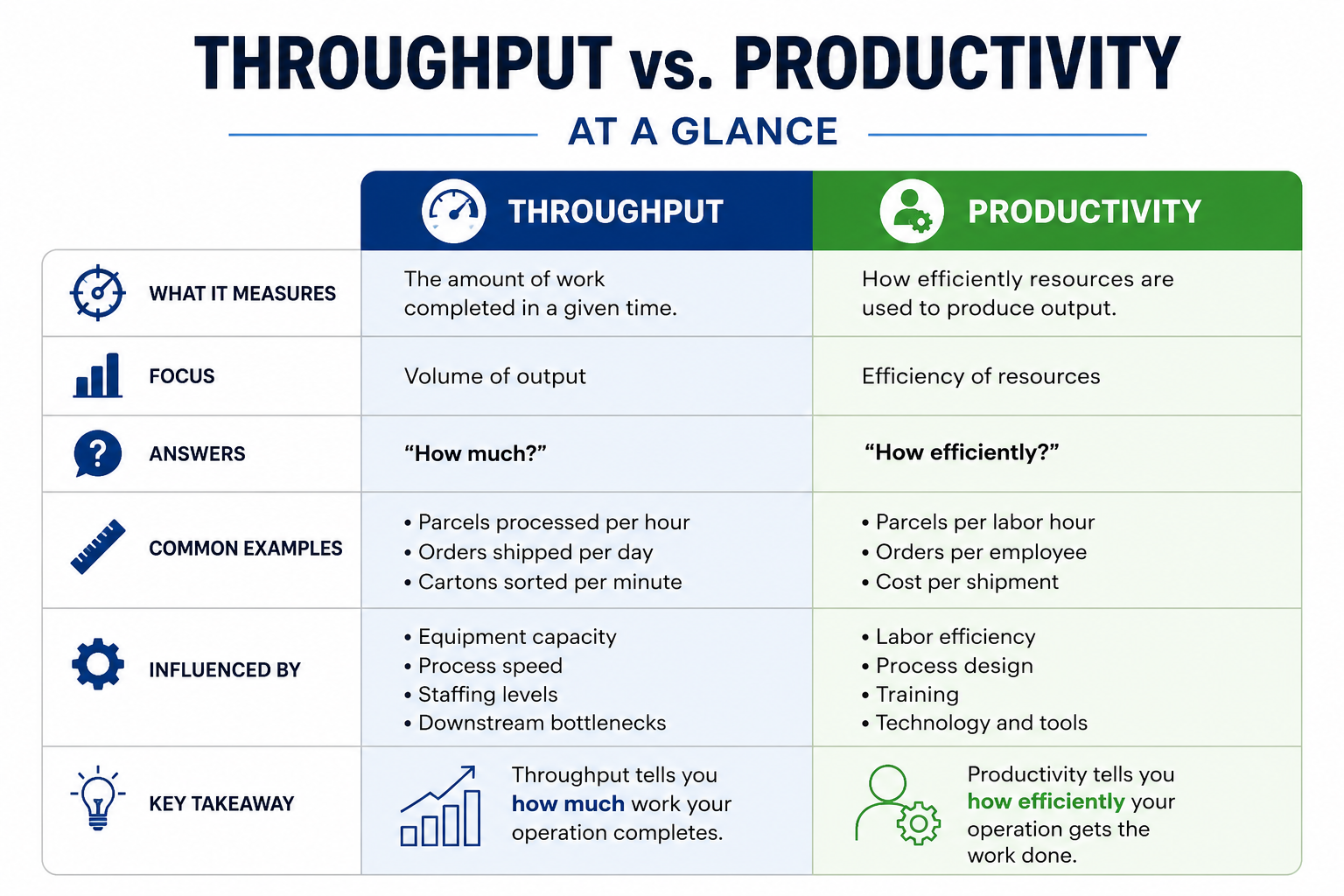
Looking at only one metric can paint an incomplete picture. The strongest operations monitor both.
Can you Improve One Without Improving the Other?
Absolutely.
In fact, this happens more often than many operations realize.
Scenario 1: Higher Throughput, Lower Productivity
Peak season arrives, and your order volume doubles.
To keep up, you bring in temporary workers and approve overtime. By the end of the week, you’ve increased daily throughput by 40%.
Success, right?
Maybe.
If labor hours increased by 60% to achieve that 40% gain, your productivity actually declined. You’re moving more packages, but you’re using resources less efficiently.
Scenario 2: Higher Productivity, Same Throughput
Now imagine you reorganize your picking area.
Employees spend less time walking between locations, travel paths become shorter, and new hires learn the process more quickly.
Your daily output stays roughly the same, but your team accomplishes it using fewer labor hours.
Why would that matter if you ship the same number of orders?
Imagine your operation is struggling to hire and retain warehouse workers, or labor costs continue to rise. Instead of adding headcount to keep pace with demand, improving productivity allows your existing team to maintain the same service levels with fewer hours. That can reduce overtime, lower operating costs, and free employees to focus on higher-value tasks without sacrificing customer expectations.
Throughput hasn’t changed, but productivity has improved.
Both outcomes can be positive depending on your business goals. The important part is understanding which metric you’re trying to improve and why.
Why Both Metrics Matter
Warehouse leaders rarely have the luxury of focusing on a single objective.
Customers expect fast shipping.
Employees expect manageable workloads.
Leadership expects costs to stay under control.
Measuring throughput without productivity can hide inefficiencies that quietly increase operating costs. Measuring productivity without throughput can mask capacity issues that eventually lead to miss service levels and delayed shipments.
The best-performing operations balance both.
Instead of asking, “How many packages did we process?” they also ask, “How efficiently did we process them?”
That broader perspective leads to better decisions about staffing, workflows, equipment, and future investments.
Where Automation Fits
Automation often enters the conversation when operations hit a ceiling.
Maybe order volume is growing faster than your workforce. Maybe labor shortages make hiring difficult. Or perhaps one manual process has become a persistent bottleneck.
The goal of automation isn’t simply to increase throughput or reduce labor costs. The right solution should improve the overall flow of work.
For example, light-directed picking systems can reduce travel time and picking errors, allowing operators to maintain consistent productivity throughout a shift. Sortation automation can eliminate manual routing decisions, helping packages move through the operation more quickly while improving accuracy. Modular automation allows facilities to address specific bottlenecks first instead of replacing an entire process at once.
When implemented thoughtfully, automation can increase throughput, improve productivity, or ideally strengthen both at the same time.
Questions to Ask About Your Operation
If you’re evaluating warehouse performance, start by asking a few simple questions:
- Where does work consistently slow down?
- Which processes require the most manual handling?
- Are labor hours increasing faster than order volume?
- Does throughput fall significantly during peak periods?
- Which bottlenecks affect the rest of the operation?
- Could a targeted process improvement remove a major constraint?
The answers often reveal opportunities that aren’t obvious when you’re looking at a single KPI.
The Bottom Line
Throughput and productivity are both valuable performance metrics, but they measure different aspects of your operation.
Throughput tells you how much work your warehouse completes.
Productivity tells you how efficiently it gets there.
Understanding the difference allows you to make more informed decisions about staffing, process improvements, and automation investments. Instead of chasing bigger numbers for the sake of bigger numbers, you can focus on building an operation that is both capable and efficient.
Because in the end, moving packages is only part of the equation. Moving them efficiently is what drives long-term operational success.