 Support
  Order Parts & Supplies

“Neither Snow nor Rain…”: Exploring Mailing Innovations Across the Decades
This is the third article in our series on the history of the USPS. In our last two articles we explored the early history and founding of the United States Postal Service. In this article, we’ll delve into four innovations developed by the USPS to meet the mailing needs of America!
Subscribe to our newsletter to stay up to date with our USPS series, company news, and more!
Rural Free Delivery: From Your Post Office to You
Serving nearly 41 million homes and businesses across rural America today, USPS’ rural delivery services help to connect people across the continental United States. However, it wasn’t always this way.
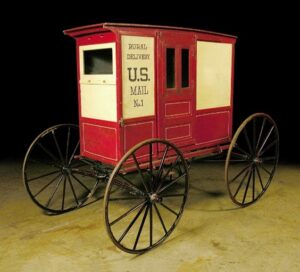
By the 1860s, most people living in cities or metropolitan areas across the country enjoyed the free home delivery services provided by the Post Office Department. However, these same services weren’t extended to those living in rural America. In rural America, people often had to travel to the nearest town, sometimes for hours, to access their local post office. As such, many post offices became centers of community, news, and banking for many rural Americans. Some Postmasters running these rural post offices would even attach general stores to their post offices to generate extra income.
The introduction of Rural Free Delivery (aka RFD) in 1896 changed everything. Now those living in rural areas could send and receive mail directly from their farms or homes. The number of active RFD routes expanded rapidly across the country with at least 44 total routes in operation across 29 states just one year after RFD started.
As newly minted RFD carriers deliver their way across the country, a surprising issue arose. You see, because most people in rural American never had mail delivered to their homes before RFD, many didn’t have “mailboxes.” People would use whatever containers they had on hand, using buckets, boxes, and even tin cans to receive mail. Locking mailboxes were also quite common. To create a standardized contraption for receiving mail, the universal mailbox that many Americans know today was created. In 1902, the mailbox would become required for customer use.
Parcel Post Goes National
It’s important to understand that at this time, many rural homes, farms, and businesses had little to no outside visitors. Often, people’s local RFD carrier was the only person “visiting” them in an entire month. There are stories of carriers being asked to help with farm work or opening mailboxes that contain lists of items for the carriers to buy and then return to the mailbox. To meet this demand, in a way, many RFD carriers became traveling post offices (and merchants), bringing the services of the post office to the doors of rural Americans. Once such service was the receiving (mailing) and delivery of packages.
“It was an instant success, with 300 million parcels mailed in the first six months the service offered. The effect on the national economy was electric.”
– Excerpt from “The 20th Century: Parcel Post” by the Smithsonian National Postal Museum
The creation of the RFD led to the birth and boom of the mail order industry in the early 1900s. Early on, both metropolitan and rural businesses alike realized that RFD services were a great way to advertise and ship products. However, there was one small issue, post offices were legally prohibited from receiving and delivering packages that weighed over four pounds. To alleviate this issue, Parcel Post would be introduced in 1913, allowing customers to send and receive packages of all weights, shapes, and sizes. The introduction of Parcel Post would expand the operations of the Post Office Department dramatically and the operations of many businesses.
Notably, Sears, Roebuck and Company (yes, that Sears) saw its order numbers increase by 5x in 1913 alone. By 1918, Sears, Roebuck and Company has doubled its revenues.
Airmail Across America
Package delivery wasn’t the only service the Post Office Department was developing at this time. During the turn of the 20th century, aviation technology was developing quickly, and the Post Office Department was keen to be an early adopter. But despite the department’s eagerness to adopt and develop air mail, they didn’t have widespread support from the rest of the U.S. government. Namely because planes weren’t planes as we know them today.
Plane travel in the early 1900s was…dangerous to put it one way. This recollection of early airmail from a white paper by the USPS helps to paint an interesting picture:
“Pilots flew in open cockpits in all kinds of weather, in planes later described as “a nervous collections of whistling wires, of linen stretched over wooden ribs, all attached to a wheezy water-cooled engine.””
– Excerpt from “Airmail: A Brief History” by the USPS
Many modern safety/navigation tools that pilots use today were developed during this time. Tools like lighted runways, spot-lit windsocks, rotating beacon towers (the precursors to radio beacon towers), and even airport boundaries were all developed in response to the needs of airmail pilots.
The U.S. Air Mail Service was initially run by the U.S. Army Air Service, with some of the earliest airmail pilot being previous U.S. Army Air Service pilots that had flown during the first world war. The Post Office Department would take control of the operation after three months; by 1918, the department had established the regular air mail routes running between Philadelphia, Washington, DC, and New York City.
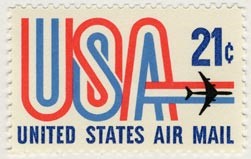
Operating the U.S. Air Mail Service was by no means an easy feat. At this time there were no civilian (privately owned) aviation or service companies that had the financial and labor resources needed to grow a continental airmail service. During the U.S. Air Mail Service’s time of operation, the Post Office Department spent around $17 million to run, manage, and develop the service. However, even the Post Office Department didn’t have the resources to continue running the service alone.
The U.S. Air Mail Service would run until 1927, by which time the 1925 Air Mail Act and the 1926 Air Commerce Act would be cleared for take-off. These pieces of legislation allowed postmaster generals to award contracts to commercial airlines to operate CAMs or contract airmail routes.
The last flight of the U.S. Air Mail Service would complete service on September 9, 1927, running from New York City to San Francisco.
Fun Fact: Enroute from Lafayette, Indiana
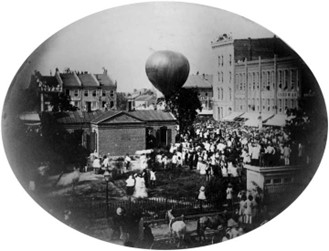
While the Post Office Department didn’t take an interest in airmail until the 1900s, the concept of delivering mail via air dates as far back as 1859. One of the earliest airmail experiments took place right here in Lafayette, Indiana!
In 1859, then-famous aeronaut John Wise concocted a plan to launch his air balloon (with a bag of mail in hand) from Lafayette and float all the way to New York City—or Philadelphia if he couldn’t make it to New York. Unfortunately, Wise only got as far as Crawfordsville, Indiana. The mail was transported the rest of the way via train.
An American Icon: The USPS Postal Truck
In the early 1900s, while the Post Office Department was experimenting with airmail, the department was also looking to improve its more grounded delivery methods. Early experiments with different types of postal vehicles showed strong promise and the Post Office Department began integrating vehicles into mail delivery services. However, the department had a much harder time integrating their postal drivers onto public roads.
Originally, the Post Office Department outsourced the employment of postal drivers to third party providers (which were usually vehicle manufacturers and suppliers). Many contract drivers made the incorrect assumption that they were above the flow of traffic and had right-of-way while operating federal vehicles. This led to the Post Office Department beginning to hire their own drivers in 1914.
“I thought I was right; we [contract mail drivers] all do it.” – A defense given by contract mail driver, John Gorgan, when asked why he was constantly driving on the wrong side of the street.”
– Excerpt from “On the Road: 1906-1920” by the Smithsonian National Postal Museum
Throughout their experiments with postal vehicles the Post Office Department tried every type of transportation possible. Trucks, cars, and even motorcycles were tested, observed, and evaluated for their efficiency and capabilities as mail delivery vehicles. By 1921, the simple truck had been determined as the clear winner in all categories; determining which type of truck was best was another question entirely.
At one point the U.S. postal fleet consisted of trucks from over 23 different manufacturers. The cost to maintain the fleet was enormous. It was time to make some cuts. The U.S. postal fleet would be consolidated to just a few select manufacturers, with the Ford Motor Company would becoming the main provider/manufacturer of postal trucks.
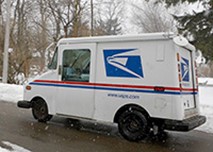
There are around 180,000 vehicles in service for the USPS today. Today’s the USPS mail trucks are usually one of two models: the Long-Life Vehicle (LLV) or the Flexible Fuel Vehicle (FFV). In 2024, USPS announced that they would be purchasing and introducing 45,000 all-electric vehicles into the fleet as part of the USPS’ Next Generation Delivery Vehicles project.