 Support
  Order Parts & Supplies

“Neither Snow nor Rain…”: Four Legendary Figures in Postal History
In the final article in our USPS history series, we’ll be looking back at four legendary figures from the story of the United States Postal Service. In our previous articles, we discussed the early history and founding of the United States Postal Service and explored mailing innovations pioneered by the USPS.
Subscribe to our newsletter to stay up to date with Eii news, industry trends, and upcoming events!
Isaac Myers: America’s First African American Postal Special Agent
During the Reconstruction era (1865-1877), the Postal Department made an active effort to appoint African Americans to positions across the nation. Major cities across the southern United States often had African American postmasters, letter carriers, and postal workers. Many would use their position to help support and build up the communities they served and lived in.
Despite this, many African American employees of the Postal Department still encountered hostility and violence from white citizens. The article “Reconstruction: Successes and Challenges,” by the National Postal Museum, recounts the experience of Postmaster Thomas G. Robinson, based on newspaper articles from the late 1870s:
“After not complying with the threats, Robinson was awakened in the middle of the night as angry white citizens shot bullets through his bedroom window. These articles all tell of hardworking, diligent postmasters who, after refusing to step down from their positions in the post office, were threatened, bullied, and even murdered by angry white townspeople.”
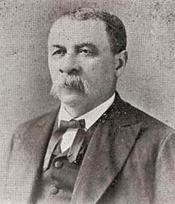
This is the time when Isaac Myers would come to work for the Postal Department. Myers was the first known African American Special Agent, appointed to the Postal Department in 1870.
During this period, Special Agents (as they were then known) were tasked with investigating all mail-related crimes, ensuring the safety of stagecoaches delivering mail, and capturing and prosecuting those committing mail-related crimes. While there is very little publicly accessible information on Myers’ time as a Special Agent, his obituary (circa 1891) mentions that Myers solved or helped to solve many cases that were famous in the late 1800s. One such case was the case of one George W. Claypole.
During his time of employment at the Baltimore Post Office, Claypole became “encouraged to dishonesty” as it’s estimated that he stole thousands of dollars’ worth of money, items, letters, and packages over the course of eight months. Claypole (working in the newspaper department) would volunteer to deliver mail. Instead of delivering mail, Claypole was opening people’s mail, taking anything valuable, and then (presumably) dumping the mail.
“On Claypole being arrested by Special Agents Henderson and Myers, he burst into tears and confessed his guilt. He gave up a package containing fifty letters…In another coat belonging to him were found hundreds of letters which he had opened and rifled…he was encouraged to dishonesty by the belief that circumstances would continue to prevent suspicion from falling on him.”
– “ARRESTED FOR ROBBING THE MAILS” by the New York Times (August 24, 1874)
Starting in the mid-1800s, workers across trades began to organize and form labor unions to advocate for better working conditions and wages. Even though they often worked the same conditions, jobs, and hours as white workers, African American workers were largely excluded from the movement and trade unions.
Before his time with the Postal Department, Myers was a prominent and key organizer in the early African American trade movement. After Myers began working as a ship caulker on the Baltimore waterfront, he started working with other Black laborers to form their own labor associations. This led to the creation of the Colored Caulkers Trade Union Society. The trade union would go on to found the Chesapeake Marine Railway and Dry Dock Company around 1866, enabling them to hire and support over 300 Black workers.
Myers remained active throughout his life, organizing trade unions and civil rights. He was a prolific and vocal member in the local African American community in Baltimore, where he ran several businesses, organizations, and even a newspaper before dying in 1891.
Opening in 2006, the Frederick Douglass-Isaac Myers Maritime Park works to preserve the memory of Isaac Myers and the history of African Americans in Baltimore’s maritime industry.
Mary Katherine Goddard: The Woman Who Published the Declaration of Independence
In some ways, Mary Katherine Goddard was always destined to be a postmaster. Her father, Giles Goddard, was a physician and a postmaster; her mother, Sarah Goddard, a well-educated woman from a wealthy family; her brother, William Goddard, would go on to found the Constitutional Post—a revolutionary alternative to the British-run postal service— the Constitutional Post would be used by the Founding Fathers to send information and organize the revolution in secret.
After the passing of her father around 1762, Mary’s family would move to Providence, Rhode Island and found the state’s first newspaper: The Providence Gazette. Around 1768, William would sell The Providence Gazette and began to found newspapers across the colonies as he traveled, leaving his mother and sister to run the businesses. In his 1962 book, William Goddard, Newspaperman, biographer Ward L. Miner shared this comment on Mary and William’s business relationship: “She was dependable and he was brilliantly erratic…”
And it does seem that William was too brilliantly erratic, even for himself, as he would complete various stints in debtor’s prison from 1771 to 1775. In 1774, William would once again hand control of one of his fledging newspapers, The Maryland Journal, over to Mary.
Fun Fact: As the Goddards moved through the colonies, William developed and published newspapers at a near-frantic pace, having a hand in at least four newspapers:
The Providence Gazette (1762)
The Constitutional Courant (1765)
The Pennsylvania Chronicle (1767)
The Maryland Journal (1773)
Under Mary, The Maryland Journal thrived, becoming an integral part of journalism, communication, and organization in the years directly before the Revolutionary War. She published reports on British activity in the colonies, revolutionary literature, and information on how those in the colonies could organize for the revolutionary cause. She also maintained publication of The Maryland Journal throughout the war years, with the Journal being the only newspaper in Baltimore circulating at various points.
Mary Katherine Goddard would be appointed as Baltimore’s postmaster under the leadership of Postmaster General Benjamin Franklin in 1775. Mary had the same dedication to running the Baltimore post office that she had to maintaining The Journal. She often paid out-of-pocket for post-riders to deliver mail to customers and to cover the costs associated with printing The Journal.
Mary would see both operations through to the other side of the Revolutionary War. In 1777, she would be given the honor of printing the first signed and printed copy of the Declaration of Independence.
“At the bottom of the broadside, issued in January 1777, she too signed the Declaration: ‘Baltimore, in Maryland: Printed by Mary Katharine Goddard.’
–Mary Katharine Goddard, the Woman Whose Name Appears on the Declaration of Independence by Eric Trickey for Smithsonian Magazine, November 14, 2018.
Mary would manage, edit, and publish The Maryland Journal up until 1784, when her brother William forced her out of the business and the position of publisher for the newspaper. It’s been implied by some sources that William did this after seeing the success of The Journal in the post-revolutionary war era. When he and his sister published competing almanacs in late 1784, William “included a screed that attacked his sister as “a hypocritical character” and insulted her “double-faced Almanack,” “containing a mean, vulgar and commonplace Selection of Articles.””
Five short years later, Mary would also be forced out of her position as the Baltimore postmaster in 1789 by the new Postmaster General Samuel Osgood. Osgood most likely did this to take advantage of Baltimore’s growing financial and political opportunities, replacing Mary with a postmaster who would be beneficial to Osgood’s career.
This disregard for women as key members of government and their communities was common at the time. While technically, women couldn’t legally be excluded from certain positions, there were no systems to prevent employment discrimination against women because of their gender. Women were banned from most entry-level clerk positions in the post office, even though it was well known that the wives of postmasters often filled these positions in practice.
Women like Mary, who were unable to attain these jobs, were systematically kept out of the circles of power needed to rise through the ranks of organizations like the Postal Department. Such factors may have contributed to the reasons that neither President George Washington nor Congress responded to the petitions submitted by Mary and Baltimore residents to have her reinstated.
John Beargrease: Star Route Legend of the North Shore
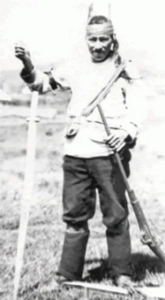
Throughout the 1800s, rural communities across the United States were often connected by just one person—their local mail carrier. These mail carriers covered millions of miles every year, visiting and delivering mail to rural residents. These hardworking men and women operated as mobile post offices (and general stores in some cases), buying and selling goods, providing services, and of course, delivering mail and news between communities. One of the most legendary mail carriers from this period was a man named John Beargrease.
John Beargrease, the son of an Anishinaabe Chief named Moquabimetem, was born in 1858 around Beaver Bay, Minnesota. Beargrease, along with his brothers, began running the star route between Two Harbors and Grand Marais, Minnesota, in 1879. At the time he (Beargrease) began delivering mail to communities along Minnesota’s North Shore, there were no formal roads, only a footpath that ran from Duluth, Minnesota, to Thunder Bay, Ontario, called the Lake Shore Trail.
Starting in 1845, the Postal Department began contracting out mail delivery and service routes to third-party providers to quickly expand mail service across the United States. Referred to as “Star Routes,” many of these contracted mail service routes focused on reaching rural/remote communities with small populations who had no formal mail service routes. Mail carriers like Beargrease became vital to the economic and communication networks of the communities they served.
Running the route twice a week, Beargrease (and his brothers) would travel the 30 hours between Two Harbors and Grand Marais. Traversing across dangerous terrain and through the equally dangerous weather along the North Shore, the men would transport up to 700 lbs of cargo, consisting of mail, furs, and additional freight. Beargrease would use a variety of transport methods to deliver mail to residents in the two towns and along the route. If Lake Superior was safe enough to navigate, boats and canoes would be used. If land was the best option, cargo would be hauled by horse or on foot. In the winter, Beargrease would travel via dogsled using a toboggan-style sled and a team of four dogs.
Beargrease would run the main star route until 1890, after which he completed smaller year-long contracts with the Postal Department for wintertime service throughout the rest of the 1890s. In 1899, the footpath that John had used to deliver mail for over twenty years would become a formal road.
John Beargrease died of tuberculosis on August 20, 1910. His condition was potentially impacted by other health-related causes he developed after saving a fellow mail carrier whose boat got caught in a storm on Lake Superior earlier that year.
Fun Fact: Running since 1980, the John Beargrease Sled Dog Marathon race runs every year along the North Shore, following the full trail path from Duluth to Grand Portage, Minnesota!
“Stagecoach” Mary Fields: The First African American Woman to Operate a Star Route Contract
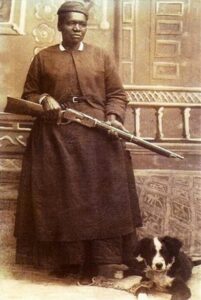
“Born a slave somewhere in Tennessee, some say in 1832, Mary lived to become one of the freest souls ever to draw a breath or a .38…,” is how legendary silent film actor Gary Cooper described “Stagecoach” Mary Fields for his article “Stagecoach Mary: A gun-toting Black woman delivered the U.S. mail in Montana” for EBONY.
Mary Fields was born around 1832 somewhere in Tennessee; her exact date of birth remains unclear, as Fields was born into slavery. Erin Blakemore, writing for History, put it succinctly in her 2017 article on Fields: “At the time, enslaved people were treated like pieces of property; their numbers were recorded in record books, their names were not.” While the story of Mary’s childhood, birthplace, and early life is virtually unknown, what is known of her legend begins after her emancipation in 1863.
In the post-Civil War era, Fields made her way to Mississippi, where she worked on the Robert E. Lee Mississippi River steamboat. She would also complete odd jobs as a maid and laundress. By the 1870s, Fields had worked her way up to Toledo, Ohio, where she lived and worked at the Ursuline Convent of the Sacred Heart. Here, Fields would forge a lifelong bond and friendship with the Mother Superior of the convent, Mother Mary Amadeus Dunne. Fields worked as the groundskeeper until the 1880s, and while it seems that Fields took pride in her work, multiple sources recount that her personality often clashed with the nuns who lived at the convent.
In 1884, Dunne would travel to Montana and work with local missionaries to establish a new Ursuline Convent and a school for Native American children. Around 1885, Dunne would fall ill with pneumonia, and Fields—after a request for additional staff arrived and learning about Dunne’s illness—traveled to Montana to assist at the new convent. Fields would nurse Mother Amadeus back to health, and Fields would begin the rest of her life in Montana.
“Mary also did the freighting for the mission and often spent the prairie nights fighting her way through storms and braving great dangers. One night, a pack of wolves frightened her team, the horses upset the load, and she stayed guard all night over the precious cargo the nuns needed to exist.”
– A recollection about Mary’s life at the convent from “Stagecoach Mary” by Gary Cooper for EBONY.
Fields worked as a hired hand at the convent for about ten years until she was fired by Bishop Brondel of Great Falls in 1894. While Fields had a penchant for smoking, drinking, cursing, and occasionally arguing with other staff, she was generally well-liked by everyone who worked at the convent. According to multiple sources, Fields’ firing was caused by an incident where Fields and another male staff member drew guns on each other during an argument.
After being forced to leave her beloved convent, Fields moved to nearby Cascade, Montana. Now in Cascade, Fields would start a new life working odd jobs and integrating into the local community. In 1895, Fields would win the star route contract running between Cascade and the convent. Fields would become the first African American woman and the second woman to win a star route contract. She would run the route every day without fail for eight years.
During this time, “Stagecoach” Mary Fields established her life in Cascade. Fields started a laundry business out of her home; she was an avid fan of the local baseball team, using the flowers from her own garden to make bouquets for players; she also enjoyed babysitting and caring for children in the town. When Fields’ house burned down in 1912, the town of Cascade rebuilt her home. Mary Fields died in 1914, her legend living on and becoming a part of the story of the “American wild west.”
“Because of scant records and the temptation to create Wild West legends out of ordinary people, many facts about Fields’ life are still fuzzy… Mary Fields didn’t need to be a myth to stand out from the crowd—but she didn’t seem to mind her outsized reputation.”
Quote from “Meet Stagecoach Mary, the Daring Black Pioneer Who Protected Wild West Stagecoaches” by Erin Blakemore for History.