 Support
  Order Parts & Supplies

How Long Does It Take a New Warehouse Employee to Become Productive?
 Hiring another employee doesn’t immediately give you another employee’s worth of productivity.
There is always a learning curve. New warehouse employees need time to understand the process, learn their surroundings, get comfortable with equipment and software, and figure out what to do when something doesn’t go exactly as expected.
So, how long does that take? There isn’t one answer.
A straightforward, repetitive job may be relatively quick to learn. A role that involves multiple processes, a large number of locations, or frequent exceptions can take considerably longer. Even two employees learning the same job won’t necessarily progress at the same pace.
For warehouse managers, the more useful question may be: What determines how quickly a new employee becomes productive, and how much of that can you control?
The Warehouse Employee Learning Curve
New employees don’t go directly from onboarding to working at the same level as your experienced operators. There’s a ramp-up period in between.
Research into behavioral order picking from Saarland University has examined this problem specifically in warehouse environments. The research highlights the impact that learning can have on order-picking performance, particularly when operations bring in temporary workers to accommodate fluctuations in demand.
That matters because adding five people to a shift doesn’t necessarily mean you’ve immediately added five employees’ worth of productivity.
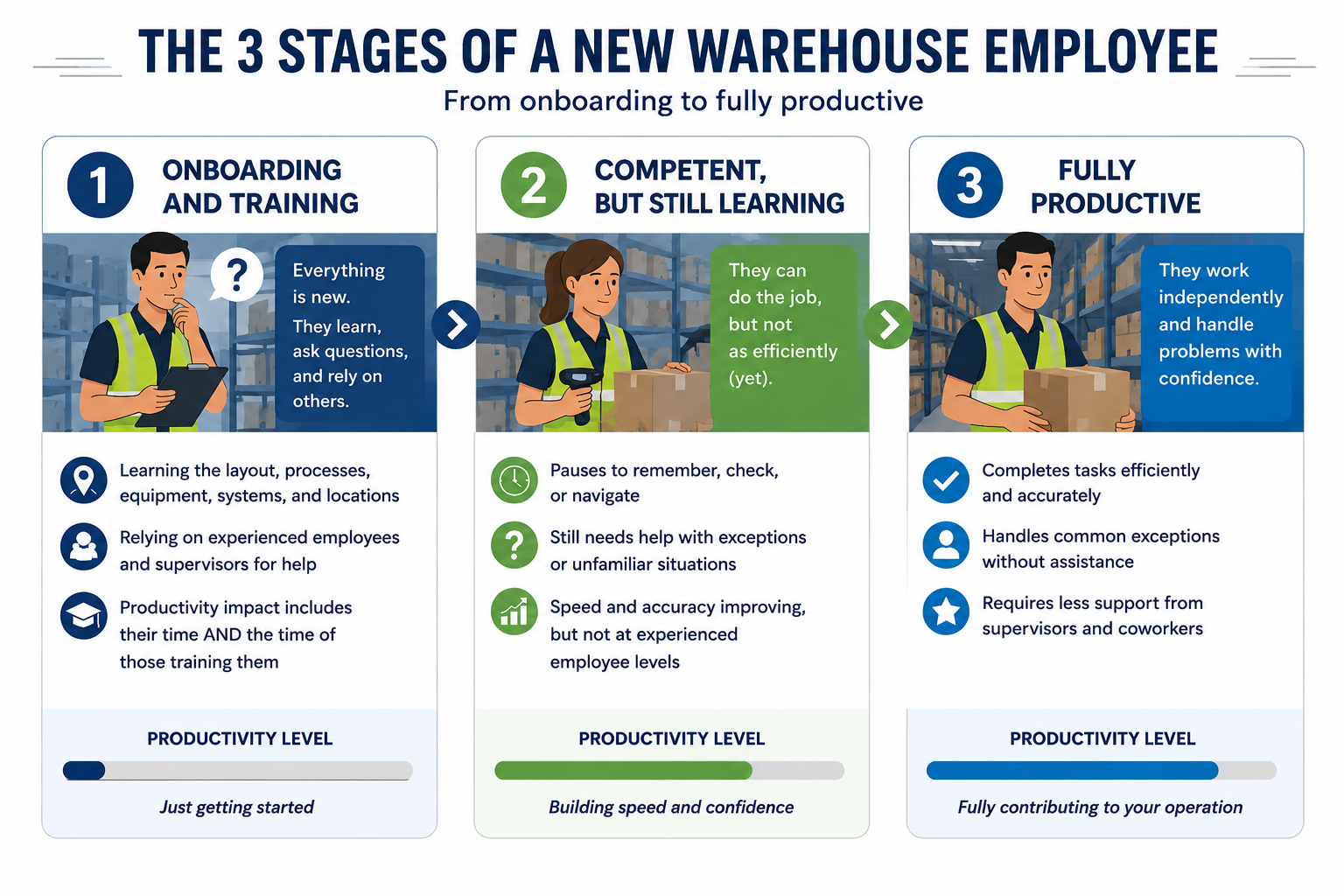
The ramp generally looks like this.
Stage 1: Onboarding and Training
At first, almost everything requires thought.
A new employee may be learning the warehouse layout, equipment, software, product locations, terminology, work instructions, and the individual steps required to complete a task.
They’re also likely relying heavily on other people. An experienced operator demonstrates a process. A supervisor answers questions. Someone stops what they’re doing to explain an exception.
That support is necessary, but it means the productivity costs of onboarding isn’t limited to the new employee. Some of your experienced labor is being used for training too.
Stage 2: Competent, but Still Learning
Eventually, the employee can complete the job without someone walking them through every step.
They’re productive, but probably not at the same level as an experienced employee yet.
They may still pause to remember a location, confirm an unusual item, navigate a software screen, or ask what to do when something falls outside the normal process.
Those pauses don’t seem like much individually. Across hundreds of picks, parcels, or orders, they add up.
This is also where the difference between knowing how to do a job and knowing it well becomes apparent. Experienced employees carry a surprising amount of operational knowledge around in their heads. They’ve seen the odd package before. They know which locations are easy to miss. They recognize when something doesn’t look right without having to stop and think about why.
New employees haven’t built that knowledge yet.
Stage 3: Fully Productive
With repetition, more of the job becomes routine.
The employee spends less time figuring out the next step and more time doing the work. They can handle common exceptions independently, navigate the operation confidently, and require less support from supervisors and coworkers.
That’s when the labor you added on paper starts looking more like the productive capacity you expected on the floor.
What makes Warehouse Employee Training Take Longer?
Sometimes the learning curve isn’t really a training problem.
The process itself may simply be difficult to learn.
Think about a task from the perspective of someone walking onto your warehouse floor for the first time. How many locations do they need to remember? How many screens do they have to navigate? How often do they need to stop and read instructions? How many decisions are based on knowledge that experienced employees have picked up over months or years?
The more a process depends on memory, searching, decision-making, or tribal knowledge, the more there is for a new employee to learn.
This becomes particularly noticeable when warehouse picking processes are put under pressure during peak seasons and return cycles. Operations may add temporary labor because they need more capacity at the same time their experienced employees and supervisors are already busy.
If every new employee needs frequent assistance from one of those experienced workers, adding headcount may not provide the immediate productivity boost you expected.
How Can Warehouses Shorten the Ramp-Up Period?
Trying to make employees learn faster isn’t necessarily the answer.
Make the process easier to learn.
Start with the places where new employees consistently slow down or ask questions. Those moments can tell you quite a bit about the process itself.
If people routinely forget the same step, the instructions may need to be clearer. If they’re spending time searching for locations, the workflow or layout may deserve another look. If only your most experienced employees know how to handle common exceptions, that knowledge needs to become part of the process rather than remaining in someone’s head.
Standardized work instructions and simpler, repeatable tasks can reduce some of that burden. Technology and process improvements to help employees work more efficiently. The important part isn’t automating for automation’s sake. It’s identifying where the process is making the employee’s job harder than it needs to be.
Use Technology to Reduce What Employees Have to Remember
Not every productivity problem requires a massive automation project.
Sometimes, a relatively simple change can remove several decisions from a manual process.
Take light-directed picking and sorting. Instead of asking an employee to memorize locations or repeatedly reference a screen or paper list, a system can visually direct them to the correct location. The employee still performs the physical task, but the process carries more of the informational burden.
That’s one of the ideas behind Engineering Innovation, Inc.’s LightSort light-directed picking and sorting systems. Lights identify where an item needs to go, giving the operator a clear visual instruction for the next step.
For an experienced employee, that guidance may make an already familiar process faster. For someone who started three days ago, it can reduce how much they need to know before they can contribute.
That’s an important distinction when evaluating warehouse automation. The question doesn’t always have to be, “What can we automate?”
Sometimes it’s, “What can we stop asking our employees to memorize?”
Don’t Just Measure Headcount. Measure Productive Capacity.
There will always be a learning curve when a new warehouse employee starts. People need time and repetition to become good at a job.
But the length and difficulty of that ramp aren’t entirely outside your control.
If an operation relies heavily on experienced employees knowing where to go, what to do next, and how to work around confusing processes, new hires have a lot of ground to make up. Adding more people may help eventually, but it won’t immediately translate into an equivalent increase in throughput.
Look at what employees actually need to learn before they can work independently. Pay attention to where new hires hesitate, where they ask for help, and where your experienced employees regularly must step in.
You may find that shortening warehouse employee training isn’t really about better training at all.