 Support
  Order Parts & Supplies

These Warehouse Automation Challenges Haven’t Changed in 20 Years
This year marks Engineering Innovation Inc.’s 20th year in business. Warehouse automation has come a long way since we started. The technology looks nothing like it did in 2006. Over that span, we’ve watched the industry evolve from basic mechanical systems into something far more capable. As a result, it changed how operations run at nearly every level.
However, even after twenty years, warehouse automation still faces some of the same challenges as it did before. These warehouse automation challenges have not gone away. Instead, they have simply taken new forms as the technology around them has advanced.
Labor Remains the Biggest Challenge in Warehouse Automation
Despite the development of automation over the last twenty years, warehouse employee turnover rates have stayed fairly consistent. Data from the Bureau of Labor Statistics, tracked by the Federal Reserve Bank of St. Louis, shows the turnover rate for transportation, warehousing, and utilities at 2.1% in July 2006 and 2.2% in July 2026. For context, there was an all-time low of 0.7% in 2003 and a high of 3.8% in 2022.
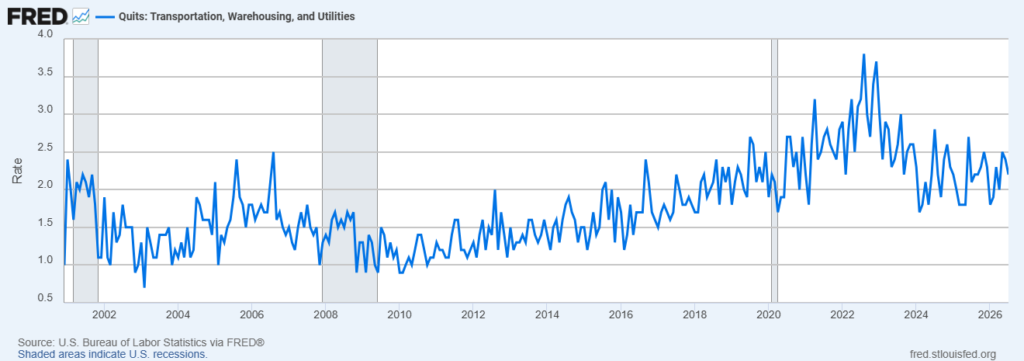
Modern Material Handling’s 2026 Top Supply Chain Trends for 2026 names the workforce and talent gap as the top issue facing supply chain leaders this year. This is driven partly by automation itself. That is, the more systems a facility runs, the more people it will need who can operate and maintain them.
Robotics adoption reflects the same pressure. MMH’s 2026 Intralogistics Robotics Survey found 52% of companies now deploy robotics, up from 48% in 2025. Companies cited reducing labor costs (67%) and labor availability (33%) as the top reasons.
Automation adoption responds to the labor problem, but it doesn’t replace solving it. As we’ve written before, technology alone cannot solve labor shortages in the parcel industry. Instead, it has to work alongside a real staffing strategy.
Volume Still Swings Harder Than Operations Plan For
Forecasting volume has improved; however, the surge hasn’t gotten easier to absorb.
The National Retail Federation, with Oxford Economics, forecasts 4.4% annual retail sales growth for 2026. This represents roughly $5.6 trillion in spending. NRF’s final count for the 2025 holiday season showed 4.1% year-over-year growth, landing almost exactly inside their own forecast. The volume swing was predicted well in advance. However, operations still had to treat it as a surge.
That’s the gap: predictable is not the same as manageable. Peak season still compresses weeks of demand into a short stretch that operations aren’t fully staffed for. Therefore, they still lean on overflow capacity and temporary labor to get through it, much as they did twenty years ago.
This is where automation earns its keep. A system that can flex output up or down without needing a proportional change in headcount is the only real defense against a demand curve that refuses to flatten. That doesn’t mean the surge disappears. Instead, it means operations have a tool for absorbing it rather than just bracing for it.
If labor and volume swings are straining your operation, you don’t have to solve it alone. Reach out to EII to talk through solutions built around your specific constraints.
The 20-Year Constant
Automation delivered on what it does best: higher throughput, fewer errors, less manual oversight. However, it hasn’t removed the constraints sitting underneath the technology. Specifically, these include people who need to be hired and trained, and demand that spikes faster than any plan can account for.
Looking back at where warehouse automation stood just a couple of years ago, the shift already underway is clear. There are fewer purely manual roles and more focus on training people for maintenance and analytical work alongside the machines. That shift keeps going. However, it’s an evolution of the labor challenge, not an end to it.
That’s why operations still need partners who understand both the systems and the realities around them. It was true 20 years ago, and it’s still true now.